stats.fm for Spotify
- 4.0
- Rating
- 10.00M
- Installs
- Free
- Price

 Analysis by App-foxy
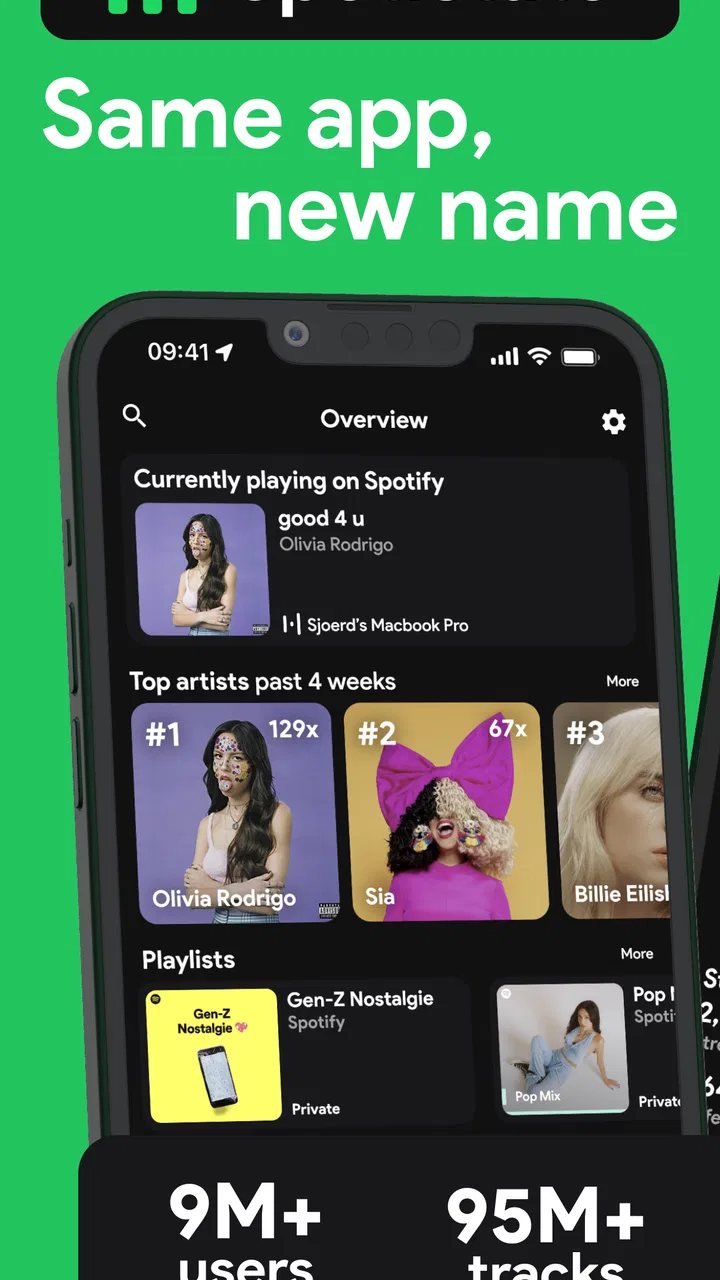
I like music apps that do more than play songs, especially when they help me understand how my listening habits change over time. stats.fm for Spotify takes that idea and turns it into a personal listening dashboard. It is a free Music & Audio app from StatsFM B.V., formerly known as Spotistats, and its focus is simple: showing patterns around the tracks, artists, and albums I listen to instead of trying to replace Spotify itself.
That distinction matters from the first minute. I do not open it expecting another streaming service, a new player, or a large discovery catalog. I open it when I want to look back at my listening, compare favorites, or satisfy the very human curiosity of seeing whether my actual habits match what I think I listen to. In my experience, that makes it more interesting after a few days or weeks of use than during the initial launch.
The app has built a substantial audience, with a 4.3 average from around 106 thousand ratings and more than 5 million installs. It is aimed at Teen users, runs on Android 7.0 and later, and the current version is 1.13.5. Those details make it accessible to many older Android phones, although the experience still depends heavily on the Spotify connection and the quality of the listening history available to the account.
You May Also Like

 Blood Strike: 2.5 Anniversary
Blood Strike’s Loadouts Turn Every Drop Into a Tactical Gamble
A close look at Blood Strike’s custom loadouts: how fast access to signature weapons reshapes its battle royale rhythm, rewards preparation, and narrows the gap between fights.

 Pandora - Music & Podcasts
Pandora’s Music Is Easy to Start, but Harder to Recover
Pandora’s strength is its low-effort path from a seed to a station. Its weak spot is how much confidence it asks you to place in connection, setup, and quiet recovery.

 8 Ball Pool
 Is Built on Rivalries, Rematches, and Routine
A close look at the rivalries, rematches, shared routines, and unanswered safety questions that turn a quick pool match into a persistent mobile community.

 Samsung Music
’s Quiet Strength Is Playing What You Already Own
Its reach comes less from spectacle than from dependable access to a personal library. That simplicity is both the app’s strongest retention engine and its ceiling.

 AccuWeather: Weather Radar
AccuWeather Review: A Quick, Clear Forecast for Everyday Decisions
For everyday plans, the best forecast is the one you can understand quickly. AccuWeather makes rain timing, radar, and local conditions easy to act on, with a few trade-offs.

 Hill Climb Racing
Why Hill Climb Racing Still Turns Crashes Into One More Run
A tiny car, a bumpy hill and one more upgrade: Hill Climb Racing keeps resurfacing because its simple chaos makes every near-miss feel personal.
More From Our News Desk



Where the first setup can become confusing
The main point where I would expect a new user to hesitate is the connection between stats.fm and Spotify. Because stats.fm is an analysis tool rather than the service that plays the music, the two apps have different jobs. Spotify remains the place for playback, playlists, and the music catalog; stats.fm interprets listening activity and presents it in a more analytical way. If someone expects to sign in and immediately see a complete personal archive, the first screen can feel less self-explanatory than a normal music app.
I recommend treating the first launch as a connection check rather than a browsing session. Make sure the Spotify account you use is the one whose listening activity you want to inspect. This sounds obvious, but it is an easy mistake when a phone has been used with more than one account or when the browser remembers a different login. A successful-looking sign-in is not enough if it connects the wrong profile.
Another useful expectation is that the app is most valuable when there is meaningful listening history to examine. A new account, a recently changed account, or an account used across several profiles may not produce the personal picture you imagined right away. That does not automatically mean the app is broken. It may simply mean the information available to it is still limited or has not yet appeared in the view you opened.
The first practical lesson is to separate account connection from data interpretation. If the account is wrong, every chart can look wrong. If the account is right but the history is still sparse, waiting and listening normally is more sensible than repeatedly reinstalling the app.
Small checks that save time before troubleshooting
Before changing anything, I would check the basics in a calm order. Confirm the Spotify username or profile shown during sign-in, then close and reopen both apps. If the phone has several browser sessions active, signing out of an unwanted Spotify account before trying again can prevent an accidental connection. I would also make sure the phone is online and that Spotify itself opens normally, since stats.fm cannot make sense of a service connection that is already failing elsewhere.
It is also worth checking whether the app is being judged too quickly. A dashboard based on listening behavior is not the same as a static profile page. Some sections become more useful after normal daily use, while other views may reflect a shorter period or a particular way of ranking activity. When a result looks surprising, I first ask whether I am looking at the right time range or category before assuming the numbers are inaccurate.
The Android requirement is forgiving: the app supports devices running Android 7.0 or newer. That helps users with older phones, but an older operating system can still bring general compatibility friction. If the application closes, displays incorrectly, or behaves inconsistently, updating the phone’s system components and Spotify is a reasonable first step. I would not treat the minimum operating system as a guarantee that every old device will feel equally smooth.
Since the app is free to install, trying it does not require an upfront purchase. There are in-app purchases ranging from $0.99 to $434.99 per item, so I would pay attention to the purchase screen before confirming anything. The free starting point is enough to decide whether the idea suits you; I would not buy anything merely to solve a sign-in or loading problem.
What to do when a page looks empty or incomplete
An empty view can have several ordinary explanations. The wrong Spotify account is one. A very small listening history is another. A temporary connection issue is also possible. My preferred approach is to compare what stats.fm shows with what I know about the Spotify account, then refresh by closing and reopening the app rather than making several changes at once.
If only one area looks unusual, I would test another area instead of assuming the whole account failed. For example, if an artist view seems incomplete but a track view loads, the problem may be limited to that section or its selected period. If every section is empty, I would return to the account connection and network checks. This simple distinction prevents a lot of unnecessary clearing of data.
I would be especially cautious about uninstalling immediately. Removing an app can erase local state and make it harder to tell whether the original issue was the account, the connection, or the app itself. A restart, a fresh login check, and a little time are safer first moves. If a reinstallation becomes necessary, I would note the account I intend to use and avoid rushing through the sign-in screen.
Building a useful listening workflow instead of checking once
The strongest way to use stats.fm is as a recurring reflection tool. I might open it after a busy month and look for the artists that genuinely dominated my listening, then compare that with the albums and tracks I remember enjoying. This is more revealing than simply checking a favorite song list because it exposes repetition, comfort listening, and unexpected habits.
A practical routine is to use the app when planning a playlist or deciding what to revisit. If I want a playlist for a long drive, I can use my top tracks and artists as a starting point, then return to Spotify to build the actual playlist. That workflow keeps each app in its proper role: stats.fm helps me inspect the pattern, while Spotify handles playback and playlist editing.
One less obvious benefit is that the app can challenge my memory. I may believe I spent a week listening to one album, only to discover that a different artist appeared more often across my routine. That can be useful when I want to broaden my listening without choosing randomly. I can identify the artists already close to my usual habits and explore outward from them in Spotify.
I also find it more useful for conversations with friends than a generic “these are my favorites” screen. Comparing top tracks or artists can reveal overlapping tastes, but it can also show how different people use music. One friend may have a concentrated listening pattern around a few albums, while another moves constantly between artists. The value is not just ranking; it is seeing the shape of a listening life.
Recovering from a misleading result
When a result feels wrong, I would avoid making a permanent judgment from one screen. First, check the selected period and whether the view is about tracks, artists, or albums. Then consider shared listening habits. If several people use the same Spotify account, the resulting profile will represent all of them, not one person. Likewise, if I listen on more than one Spotify profile, stats.fm cannot create a single accurate picture unless the activity belongs to the account I connected.
This is one of the app’s most important trade-offs. Its results can be very personal when the account is personal, but they become less meaningful when the source history is mixed. That is not something a statistics interface can magically correct. In a shared household, I would treat the charts as a record of the account’s behavior rather than as my private taste.
If the app stops updating, I would check Spotify first. Can I play music normally? Is the intended account still active? Does the connection need to be authorized again? After those checks, I would restart stats.fm and allow a little time for the view to catch up. I would avoid repeatedly logging in and out unless the account itself appears wrong, because unnecessary changes can create more confusion than they solve.
A useful recovery habit is to change only one thing at a time. If I update Spotify, clear app storage, reinstall stats.fm, and switch accounts together, I lose the ability to identify what helped. Testing the account, then the connection, then the app state produces a much clearer answer. This is basic troubleshooting, but it is particularly helpful here because the app depends on another service.
When the app is not the cause
It is easy to blame stats.fm when the real issue sits with Spotify, the phone, or the account. If Spotify is unavailable, repeatedly asking the statistics app to reload will not fix the underlying service. If the phone is low on storage or aggressively stopping background activity, other apps may also behave strangely. If the account has changed, the charts may look different even though stats.fm is working exactly as connected.
Network conditions can create a similar illusion. A page that loads halfway on a weak connection may look like missing history. I would switch between a reliable Wi-Fi connection and mobile data only as a test, then reopen the app. If the behavior changes with the network, that points away from the charts themselves and toward connectivity.
There is also a difference between a data problem and a preference problem. Perhaps I dislike the way a particular ranking is organized, or I expected a broader historical view. That does not necessarily mean the app has failed; it may mean my preferred music workflow needs a different tool. Spotify is better for listening and managing playlists, while stats.fm is better for examining the listening that already happened.
For users who want a full music player, offline playback, radio-style discovery, or a replacement for Spotify, this is probably the wrong download. The app’s appeal depends on curiosity about listening statistics. If I never look at patterns or compare my habits, I would get more value from staying inside Spotify and using its own listening features.
How it compares with the usual alternatives
Compared with Spotify’s normal listening interface, stats.fm feels more focused on reflection than action. Spotify is where I search, play, save, and organize music. stats.fm gives me a different lens on that behavior. I would not choose one as a total replacement for the other because they answer different questions.
Compared with a simple notes list of favorite songs, the app is more useful when I want patterns rather than personal opinions. A manually maintained list can be quicker for a handful of favorites, but it depends on me remembering to update it. stats.fm is appealing precisely because it turns listening activity into something I can inspect without maintaining a separate diary.
Compared with broad music-discovery services, it is less useful when I want unfamiliar recommendations immediately. Its strength is looking inward at my Spotify activity, not presenting itself as a competing catalog. Someone who wants to discover new releases without analyzing past behavior may find the app unnecessary.
That makes the audience fairly clear. I would recommend it to Spotify listeners who enjoy end-of-month reflection, playlist building from real habits, friendly comparisons, or tracking how their taste shifts. I would skip it if I want one app for playback, if my Spotify account is shared, or if I find rankings more distracting than helpful.
My practical verdict after using it
stats.fm for Spotify is a focused companion rather than a complete music destination. I like that it gives my listening history a shape I can actually discuss and use. The most rewarding moments are not the first glance at a top track, but the later discoveries: the artist that quietly dominated my routine, the album I returned to more than expected, or the gap between what I remember and what I really played.
The setup deserves patience. Confirm the right Spotify account, test Spotify itself, use a stable connection, and give the history time to become meaningful. When something looks incomplete, check the period and category before reinstalling. Those habits solve many of the frustrations that might otherwise be blamed on the app.
StatsFM B.V. has made a free app that is easy to try, with a Teen content rating and broad Android support starting at version 7.0. Its 1.13.5 release is the version I would look for when checking compatibility. The presence of optional purchases means I would explore the free experience first and make any spending decision only after understanding what I personally want from the extra options.
My recommendation is simple: install it if you want to understand your Spotify habits, not if you want another Spotify. For a curious listener with a personal account and enough history to analyze, it can become a surprisingly enjoyable monthly ritual. For everyone else, especially people seeking playback or discovery first, Spotify itself remains the more practical home.
FAQs for stats.fm for Spotify
01What exactly does stats.fm for Spotify do?
Stats.fm for Spotify, formerly known as Spotistats, provides detailed insights into your Spotify listening habits. It tracks your most played songs, artists, and albums over various timeframes. Users can also see personalized stats like total listening time and compare their music preferences with friends, offering a comprehensive view of their music journey.
02Is stats.fm for Spotify free to use?
Stats.fm offers both free and premium versions. The free version provides basic insights, while the premium version unlocks more detailed analytics and features such as extended data histories and more personalized reports. Users can choose based on their needs and how in-depth they want their music statistics to be.
03How does stats.fm for Spotify ensure my data privacy?
Stats.fm prioritizes user privacy by only accessing the necessary data from your Spotify account to generate statistics. It complies with Spotify’s API usage guidelines, ensuring that your data is handled responsibly and securely. Users have control over what information is shared and can disconnect their Spotify account at any time.
04Can stats.fm for Spotify be used on both Android and iOS devices?
Yes, stats.fm is available for both Android and iOS platforms. Users can download the app from Google Play Store for Android devices and the Apple App Store for iOS devices. The app is designed to provide a seamless experience across both platforms, making it accessible for a wide range of users.
05Do I need a Spotify Premium account to use stats.fm?
No, you do not need a Spotify Premium account to use stats.fm. The app works with both free and premium Spotify accounts. However, having a Spotify Premium account might enhance the experience by removing ads and offering more integration features, though the core functionalities of stats.fm remain accessible to all users.
Pros
- Intuitive interface for easy navigation.
- Detailed listening stats and insights.
- Connects seamlessly with Spotify.
- Customizable data views and reports.
- Frequent updates with new features.
Cons
- Requires Spotify Premium for full access.
- Occasional sync issues with Spotify.
- Limited offline functionality.
- Some features locked behind paywall.
- Initial setup can be time-consuming.

stats.fm for Spotify
Gallery